A family bed can make co-sleeping feel calmer, but choosing the right setup involves far more than bed width. You also need to consider who will be sleeping in the bed, how you use the room, which mattresses you prefer, and whether a complete family bed or a DIY extension kit is the best fit for your home.
This guide walks you through the decision from start to finish. The goal is not to find the largest possible bed, but a setup that gives your family plenty of space, works well in the room and is practical for everyday life. Work through the decision in this order: needs, size, room, mattress, safety, solution type and accessories.
1. Start with what your family really needs
Start by looking at what your nights are really like. How many people regularly sleep in the bed? Does a child only join you during the night? Do you need extra space during illness, breastfeeding or restless periods? And do you expect your needs to change as your children grow?
Also think about what is not working in your current setup. It might be a lack of space, a noticeable join between the mattresses, uneven bed heights or insufficient support. Once you have identified the specific problem, it becomes easier to choose a setup that genuinely solves it.
Make a note of who sleeps in the bed on a typical night.
Note when the bed begins to feel cramped.
Consider whether you need a permanent setup or one that can adapt over time.
Agree on the features that matter most to you, such as a continuous sleeping surface, firmness or easy cleaning.
2. Choose the right width for who sleeps there and how they sleep
FamBed family beds come in modular configurations from 200 to 360 cm wide, allowing the bed to be tailored to different families and rooms. But choosing the right width involves more than simply counting the number of people sharing the bed. Sleeping positions, movement during the night and your children's ages all matter too.
If an adult or child moves around a lot at night, you may need more space than expected. Your needs may also differ depending on whether a child joins you occasionally or you co-sleep every night. Consider whether everyone needs to be able to get in and out without waking the rest of the family.
Remember that sleeping width and overall bed dimensions are not the same. Headboards, side panels and the bed's construction can all affect how much floor space it takes up. Always ask for the exact product dimensions before making your decision.
Decision diagram showing how to choose a family bed width.
3. Measure the room with everyday use in mind
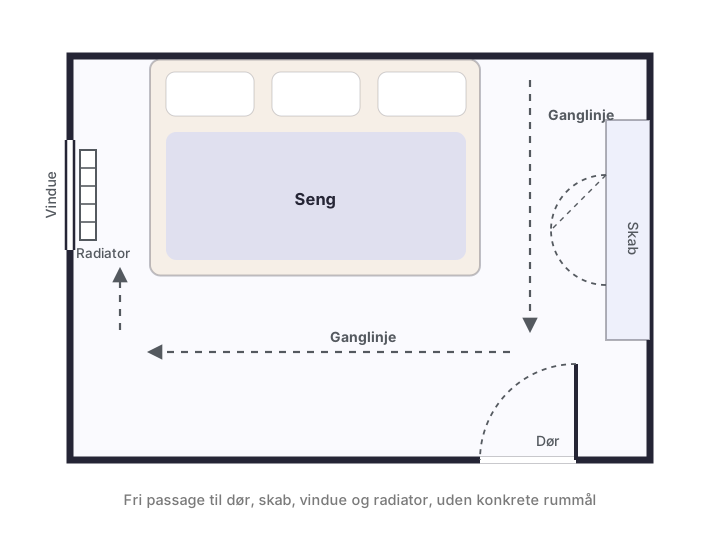
A bed may physically fit into a room without leaving the space practical to use. So measure more than just the available wall space. Consider doors, wardrobes, drawers, radiators, windows, power sockets and the routes you take through the room at night.
Measure the available floor space and note any fixed fittings.
Mark how doors and wardrobes open and how far drawers extend.
Check how everyone will get into and out of bed.
Use masking tape or movable objects to mark out the bed's expected footprint on the floor.
Marking out the footprint on the floor makes it easier to judge the proportions than measurements on paper. Walk around it, open the wardrobes and imagine a typical night when an adult needs to get up without turning on a bright light or disturbing anyone else.
Floor plan showing measurement points and walking routes around a family bed.
4. Choose your mattress and mattress topper carefully
Comfort is personal. Some people prefer a firmer surface, while others like a softer feel. Consider the adults' usual preferences, sleeping positions and how they find their current bed. Children should also have a sleeping space suited to their current needs.
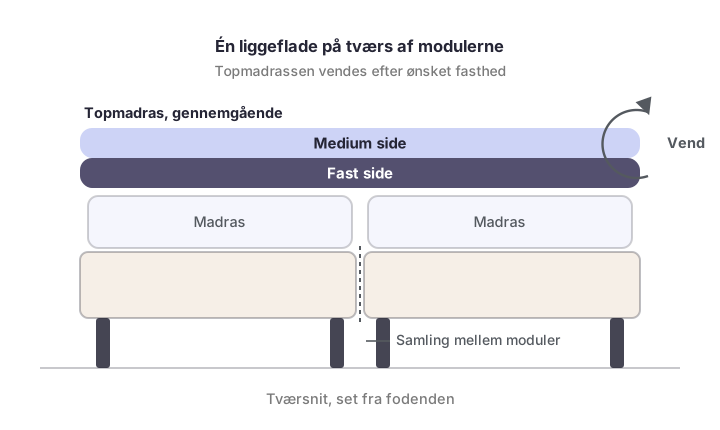
A FamBed mattress topper with reversible medium and firm sides lets you try two different sleep surfaces. If the first side does not feel right for your family, you can simply turn the topper over. It is still important to ask how the topper works with the mattresses underneath.
Ask whether the firmness rating applies to the mattress topper, the mattress or the bed as a whole.
Find out how the joins between the bed modules are levelled out.
Check whether the cover is removable and how it should be cared for.
Decide beforehand whether firmness or an even sleeping surface matters most.
If your comfort preferences are very different, explain them clearly to the retailer. Ask which combinations are available and how one continuous mattress topper will affect the feel of the mattresses underneath.
Reversible mattress topper with medium and firm sides on a modular family bed.
5. Consider safety in its own right
Safety should be assessed across the entire setup, not just one product. The bed, mattresses, mattress topper, any bed bridge, legs and position in the room all need to work together. Always follow the manufacturer’s assembly instructions and recommendations for use.
Check that the structure is stable and assembled according to the instructions.
Check for unintended gaps between the bed, mattresses, walls and other furniture.
Make sure the mattresses and any bed bridge fit your chosen setup.
Assess access, fall risks and the room layout in light of your child’s age and development.
Ask for documentation covering relevant testing, materials and maintenance.
No general guide can replace an assessment of your specific setup. Your family’s needs will also change, so reassess the bed as your children grow or whenever you change the mattresses, position or modules.
6. DIY extension kit or ready-made family bed
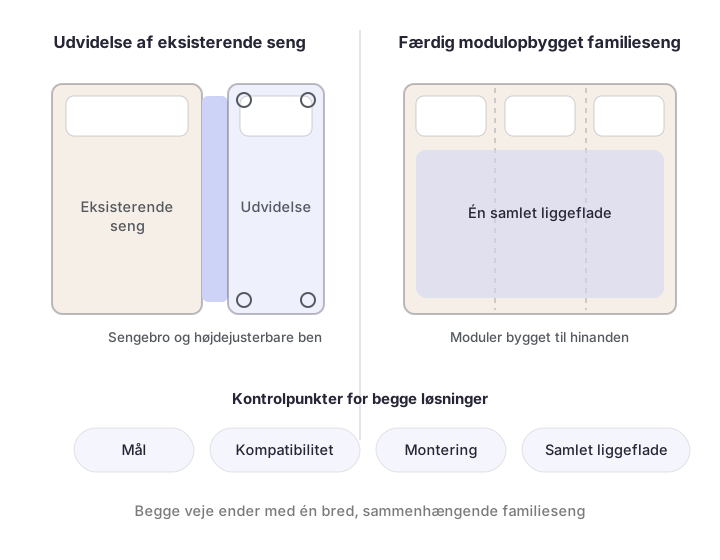
A DIY extension kit may be worth considering if you already have a bed you'd like to extend. FamBed's kit includes height-adjustable legs and a bed bridge. The legs help align the bed sections, while the bed bridge sits over the join between the mattresses.
A DIY setup can work well if:
You want to keep an existing bed or mattress.
Your room requires a more customised setup.
You're happy to measure, assemble and check the entire setup yourselves.
A ready-made family bed can work well if:
You want a complete solution with modules chosen to work together.
You want to minimise the work involved in combining different beds and matching their heights.
You want one supplier to turn to with questions about the bed, mattresses and accessories.
DIY isn't necessarily the simplest or cheapest option, and a ready-made bed isn't necessarily right for everyone. Compare the full undertaking: components, compatibility, assembly, comfort, delivery and how much of your own time it will take. Starting prices are listed on the product page.
Comparison of a DIY extension kit and a ready-made family bed.
7. Don’t forget bedding and everyday practicalities
Custom sizes mean you need to consider both the bedding and the overall look before ordering. The sheet must fit your chosen mattress and mattress topper, while the bed skirt must suit the bed’s configuration and your preferred look. You should also ask how each item is washed, fitted and removed.
Think about everyday life when illness strikes, accidents happen or the bedding needs changing. The most elegant option is not necessarily the most practical if the textiles are difficult to handle. Add the accessories to your shopping list from the start instead of treating them as an afterthought.
8. The key questions to ask before buying
It’s worth sending all your questions to the retailer at once. This makes it easier to compare the answers and spot any missing information.
What are the bed’s overall external dimensions, and what is the actual sleeping area?
Which parts are included, and which need to be ordered separately?
How are the modules connected, and how is the join between the mattresses handled?
Which mattresses and mattress toppers are suitable for this particular configuration?
How should we check and maintain the joints, legs and other parts?
What documentation is available on safety, materials and testing?
How will the bed be delivered, and what will we need to assemble or prepare ourselves?
Which sheets and bed skirts fit the chosen size and configuration?
Before making your final decision, read FamBed’s guide to family bed safety, standards and testing. Use it alongside the product instructions and an assessment of your child, room and setup.
In short
The best family bed is one that suits both the people sleeping in it and the room itself. Start with your sleeping habits, then choose the width, check that the room still works, decide what you need from your mattresses and assess the safety of the entire setup. Finally, compare DIY and ready-made solutions on more than price alone. Once those choices are settled, it becomes much easier to choose a FamBed solution that works for your family’s everyday life.




 Co-sleeping: discussion, tips, tricks and guides
